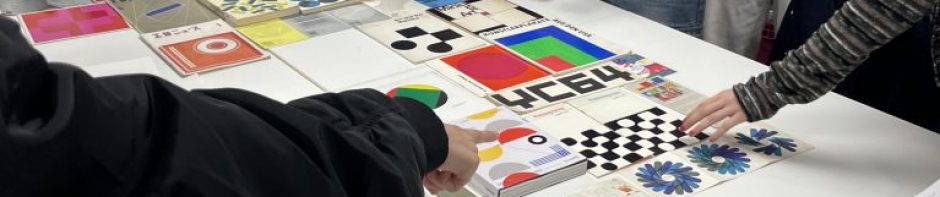
This report reflects on the design of an inclusive curriculum intervention within the BA Graphic Branding and Identity course, Year 1. My intervention focuses on redesigning a Visual Grammar session to improve accessibility, engagement and participation for a diverse student cohort.
My positionality as both an academic and practising designer shapes my understanding of learning within design education. My teaching ethos is further informed by my experiences as a neurodivergent learner, a first-in-family graduate and an English as an Additional Language (EAL) speaker. Drawing on Haraway’s (1988) concept of situated knowledges, I recognise that teaching and learning are shaped by social and cultural perspectives rather than neutral or universal viewpoints. These experiences shape how I approach barriers to participation, belonging and success within higher education.
This report explores the intentions, rationale and implications of an intervention designed to make design principles more accessible and widely understood whilst maintaining academic rigour.
As Year 1 Lead for BA Graphic Branding and Identity, I have had the opportunity to reshape the curriculum following the recent course validation and my appointment to the role. This intervention focuses on a Visual Grammar session, which introduces students to foundational design principles that underpin later work in visual identity design.
The cohort comprises students from diverse educational, cultural and creative backgrounds. Students enter higher education with varying levels of design knowledge, technical confidence and familiarity with academic study, which can influence engagement with abstract disciplinary concepts.
This session is significant as it establishes conceptual foundations for subsequent units and projects. Improving accessibility and engagement at this stage has the potential to support students’ confidence, participation and understanding throughout their first year.
Inclusive learning is paramount within design education as students engage with abstract concepts, specialist terminology and critique-based pedagogies that can unintentionally privilege specific forms of knowledge and participation. Whilst design disciplines often celebrate creativity and innovation, access to learning is not always equitable.
Although disability remains underreported at UAL (UAL, 2025), the proportion of students declaring a disability (18.4%) is significant and should inform how learning experiences are designed and delivered. Furthermore, neurodivergent individuals appear to be overrepresented within creative professions, with 48% of creative professionals identifying as neurodivergent compared with 31% of the wider workforce (Understood.org, Havas and 4As, 2024). This highlights the importance of designing curricula that anticipate learner variability from the outset rather than relying solely on individual adjustments.
The PGCert readings encouraged me to consider how learning environments and institutional structures shape students’ experiences of higher education. Using an intersectional framework, Hu (2024) highlights how international students’ experiences are shaped by racialised, gendered and class-based inequalities within higher education. Rather than seeing issues around participation, confidence or belonging as individual shortcomings, Hu argues that these experiences are often linked to wider institutional and social structures. This resonated with me and reinforced the idea that barriers to learning are not always located within the student. Similarly, Arday et al. (2021) suggest that universities can be exclusionary spaces, where dominant norms and assumptions create barriers to participation and success. Together, these perspectives encouraged me to think more critically about how curriculum design and learning environments can either support or exclude different groups of students.
In response to these ideas, the redesign of the Visual Grammar session was informed by the principles of Universal Design for Learning (CAST, 2024), which advocate providing multiple ways of engagement, representation, and action and expression. Rather than expecting all students to learn through a traditional lecture format, the revised session incorporates visual examples, practical activities, opportunities for discussion and flexible ways of engaging with content. By offering multiple entry points into learning, the intervention aims to reduce barriers and support diverse learners whilst maintaining academic rigour.
My thinking was initially informed by observations of student engagement within the existing session. Students appeared increasingly passive as the lecture progressed and struggled to connect theory with practical design outcomes. Informal conversations suggested that students valued opportunities to learn through making, discussion and experimentation.
My positionality also influenced how I interpreted these observations. As a neurodivergent learner and EAL speaker, I am aware of how cognitive load, disciplinary language and implicit expectations can affect participation. Whilst my experiences are not representative of all learners, they have encouraged me to question assumptions about what constitutes effective engagement within design education.
Reading Hu (2024) prompted me to reconsider my interpretation of student engagement. Rather than viewing difficulties in participation or understanding as evidence of individual capability, I began to consider how the learning environment itself might create barriers. This perspective resonated with my observations and strengthened my decision to focus on redesigning the curriculum experience. Engagement with the Inclusive Practices unit further reinforced this shift towards viewing inclusion as a curriculum design issue.
Although feedback from my blog groups was limited, student feedback from previous iterations of this session indicated that practical activities and opportunities for discussion were more engaging than extended lecture-based delivery. Further discussions with course colleagues also reinforced the value of creating more active and accessible learning experiences. The consistency between student feedback, colleague discussions and relevant literature increased my confidence that the issues identified warranted intervention.
A key decision was to redesign the session rather than introduce additional support mechanisms, focusing on reducing barriers within the learning experience. I also offered individual student support, through more comfort breaks and extended tutorial provision. However, redesigning the session aligned more closely with the principles of inclusive curriculum design because it sought to address barriers within the learning experience rather than requiring learners to adapt to it.
This led to the decision to break content into smaller segments, integrate practical activities throughout the session, provide contemporary visual examples and offer more flexible opportunities for discussion. I also considered introducing asynchronous elements to allow students to engage with theoretical content at their own pace before applying concepts through workshop-based activities.
A key challenge involved balancing accessibility with academic and disciplinary rigour. Whilst simplifying delivery may improve engagement, there is a risk of oversimplifying important theoretical concepts. Similarly, greater flexibility can create risks around reduced structure, uneven participation and inconsistent engagement with asynchronous materials.
Watermeyer and Swartz (2023) caution against simplistic applications of intersectionality that fail to reflect the complexity of lived experience. This prompted me to avoid making assumptions about particular groups of students and instead focus on creating flexible learning environments that support a broad range of learners.
These challenges reinforced the importance of maintaining academic standards whilst providing multiple entry points for students to engage with and demonstrate learning.
Overall, this process led me to view the redesign of the Visual Grammar session not as a discrete teaching adjustment, but as an opportunity to embed inclusion more intentionally within curriculum design.
Having gone through this learning cycle, I fully intend to integrate this intervention into the curriculum and apply these inclusion approaches and learning environments to further sessions.
I will also provide familiar points of reference from which students can explore new concepts, helping to establish a more inclusive starting point for learning. Content will be structured into shorter segments, with practical activities embedded throughout to encourage immediate application and reinforce understanding.
I also intend to redesign presentation materials to reduce cognitive load, prioritising visual communication over text-heavy delivery and supporting learning through contemporary visual examples.
Flexible workshop activities will allow students to work at their own pace through analogue and digital approaches to accommodate different levels of confidence and dexterity. Scheduled breaks will support concentration and wellbeing. I also intend to optimise session timings to ensure space for group critique and reflection.
Longer-term developments may include delivering selected theoretical content asynchronously, creating more time for discussion, experimentation and feedback during taught sessions.
Collectively, these changes aim to create more accessible, engaging and inclusive learning experiences while maintaining academic rigour. They also represent a shift in my practice towards designing learning environments that proactively reduce barriers to participation rather than responding to them after they emerge.
The intervention process has reinforced my understanding that inclusion should be embedded within curriculum design rather than added retrospectively through individual accommodations.
It also encouraged me to reflect critically on assumptions embedded within my own teaching practice. Whilst personal experience informed my awareness of potential barriers, engagement with educational literature and peer discussion helped me move beyond individual perspectives and consider broader structural issues affecting participation and belonging.
The intervention could be evaluated through mid-unit student feedback, participation levels, application of visual grammar concepts in subsequent projects, unit evaluation and peer observation. Success would not be measured solely through attainment but through evidence of increased confidence, engagement and participation across a diverse range of learners.
My positionality as a practising designer, neurodivergent learner, first-in-family graduate and EAL speaker shaped my awareness of potential barriers within higher education. However, engagement with literature on positionality, intersectionality and inclusive learning strengthened my understanding of how these experiences connect to broader questions of power, participation and equity.
Ultimately, the process has reinforced the importance of designing learning environments that anticipate learner diversity, reduce unnecessary barriers and support meaningful participation for all students.
References
Arday, J., Branchu, C. and Boliver, V. (2021) ‘What do we know about Black and Minority Ethnic (BAME) participation in UK higher education?’, Social Policy and Society, 21(1), pp. 12–25.
Bilgen, A., Nasir, A. and Schöneberg, J. (2021) ‘Why positionalities matter: reflections on power, hierarchy, and knowledges in “development” research’, Canadian Journal of Development Studies / Revue canadienne d’études du développement, 42(4), pp. 519–536. Available at: https://doi.org/10.1080/02255189.2021.1871593.
CAST (2024) Universal Design for Learning Guidelines Version 3.0. Wakefield, MA: CAST. Available at: https://udlguidelines.cast.org (Accessed: 3 June 2026).
Haraway, D. (1988) ‘Situated knowledges: The science question in feminism and the privilege of partial perspective’, Feminist Studies, 14(3), pp. 575–599.
Harpur, P., Szucs, B. and Willox, D. (2023) ‘Strategic and policy responses to intersectionality in higher education’, Journal of Higher Education Policy and Management, 45(1), pp. 19–35.
Hu, M. (2024) ‘International students’ feeling of shame in the higher education: An intersectional analysis of their racialised, gendered and classed experiences in the UK universities’, Sociology Study, 14(1), pp. 69–89. Available at: https://doi.org/10.17265/2159-5526/2024.01.006.
Nichols, S. and Stahl, G. (2019) ‘Intersectionality in higher education research: a systematic literature review’, Higher Education Research & Development, 38(6), pp. 1255–1268. Available at: https://doi.org/10.1080/07294360.2019.1638348.
Understood.org, Havas and American Association of Advertising Agencies (4As) (2025) Unlocking Neurodiversity: A Creative Advantage. New York: Understood.org. Available at: https://www.understood.org/en/press-releases/2025-creativity-research (Accessed: 5 July 2026).
University of the Arts London (2025) UAL EDI Report 2025 [PDF]. London: University of the Arts London. Available at: https://www.arts.ac.uk/__data/assets/pdf_file/0023/561434/EDI-Report-2025.pdf (Accessed: 5 July 2026).
Watermeyer, B. and Swartz, L. (2023) ‘Disability and the problem of lazy intersectionality’, Disability & Society, 38(2), pp. 362–366.
Firstly, the slides you show on your proposal page look amazing. I wish my powerpoints looked like that. Alas, I am a tasteless camera nerd!
Interesting reading how you’re structuring this to better include neurodiverse students. I’m actually adding a new theory-heavy segment to my own lighting sessions at the moment (covering skin-tone bias in photography) and reading this has made me reconsider how I’m planning to deliver it. I’d defaulted to a fairly traditional presentation format, but your point about breaking content into smaller segments and building in practical/discussion rather than one long lecture block is interesting. I don’t want to introduce something inclusive in content but exclusionary in delivery.