Context
As a Year 1 Lead of BA Graphic Branding and Identity, it is my role to design and deliver the Year 1 curriculum. Following course validation, my appointment to the role provided an opportunity to rethink how the curriculum is delivered and how in-person sessions could be used more effectively.
At Year 1 level, we welcome students with diverse levels of design knowledge, technical ability, and academic experience. Block One therefore serves as a foundation and levelling stage, ensuring students develop a shared understanding of branding, design theory, and practice before progressing to more complex applications.
Aims
I would like to design an intervention around curriculum delivery to make learning more inclusive, accessible, and engaging for the entire cohort. Particular consideration will be given to neurodivergent learners, students entering higher education through non-traditional routes, and students with English as an Additional Language (EAL), who may require additional support when adapting to UK higher education practices and disciplinary language.
The challenge
One session I continually revisit is the Visual Grammar session, where students are introduced to core design principles that underpin the development of effective visual identities.
Whilst this content is fundamental to students’ development as designers, its abstract nature can create barriers to engagement, understanding, and application.
Pain points
Historically, this session has been delivered through a predominantly lecture-based format, with limited opportunities for students to apply concepts through practice. For many students, understanding only emerged once theory was explored through workshop activities.
During previous deliveries, student engagement often declined as the session progressed. The abstract nature of the content proved particularly challenging for students with different learning preferences, varying levels of academic preparation, or EAL needs.
There was also a clear gap between theory and practice. Students frequently struggled to apply design principles intentionally within their work or articulate the reasoning behind their design decisions, resulting in less considered outcomes.
The plan
To address these challenges, I will redesign the session using active learning approaches that prioritise practical application alongside theory.
Rather than assuming prior knowledge, the session will begin by drawing parallels between written and visual grammar, providing an accessible entry point into the subject. Concepts will then be introduced in manageable sections, each followed by short practical exercises and comfort breaks to support concentration and engagement.
To support understanding of abstract ideas, I will incorporate contemporary design examples that demonstrate each principle in practice. These references will help students connect theoretical concepts to real-world design outcomes.
The presentation itself will be streamlined and more visually led, reducing cognitive overload by condensing content and prioritising imagery, examples, humour, and visual storytelling to reinforce key messages.
In response to student feedback regarding the pressure of timed creative tasks, workshop activities will be redesigned to allow for greater flexibility and self-paced learning. Students will be able to revisit materials and complete activities at a pace that supports their learning, followed by a structured pin-up critique in the subsequent session to encourage reflection and consolidation.
To further enhance inclusivity, I would like to explore a blended approach in which selected theoretical content is delivered asynchronously before class. This would create additional studio time for experimentation, discussion, peer learning, and creative practice.
Finally, I would like to introduce alternative methods of participation for students with dexterity challenges or differing access needs. Alongside analogue activities, students will have the option to create outcomes digitally using industry-standard software, reducing barriers associated with manual making processes.
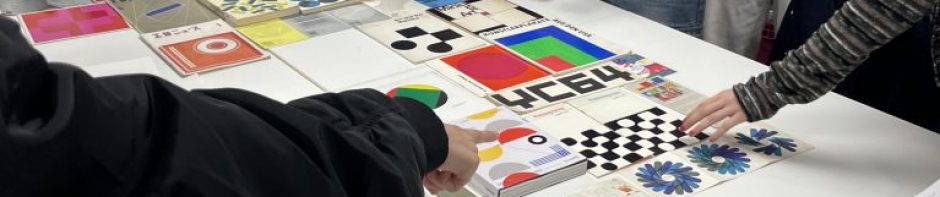
Examples below, show some examples of how lectures could be more visual.

There’s also some examples of creative exercises I have previously curated for students. I would like to create more opportunities for visual experimentation.