Plan for and support student learning through appropriate approaches and environments
Contextual Background
In my BA (Hons) Graphic Branding and Identity teaching, students frequently ask how to create visually engaging and unexpected logos and visual identities. Reviewing the course, I realised we do not explicitly support students’ learning, nor provide tools for idea generation or concept development approaches during our taught and self-directed studio sessions.

Example slides from presentation where I shared some approaches to logo design and encouraged students to ideate by breaking down a large problem into smaller more doable chunks.
Evaluation
Although the course handbook had limited scope, it provided an opportunity to introduce idea-generation practices. I planned and delivered lateral-thinking warm-up exercises, design sprints, and masterclasses on logo creation and concept development. These hands-on activities created an active studio environment that supported experimentation and applied learning. The approach helped reduce perfectionism and reframed failure as part of the creative process. Student feedback was mixed: some valued being pushed beyond their comfort zones and requested more sprints, while others felt rushed or put on the spot. Overall, students reported gaining practical tools and frameworks that supported idea generation and helped them develop confidence within a structured yet exploratory learning environment.
Moving Forward
Student-centred creative development: I have adopted a student-centred approach that recognises differences in pace, confidence, and learning styles while supporting growth within a creative and safe learning environment. My approach balances structure with autonomy by adapting idea-generation sessions to be more self-led while also offering drop-in tutorials for students who felt stuck or required reassurance.
To further nurture creative confidence, I introduced open-ended creative play through warm-up exercises and lateral-thinking activities embedded within project-based work. These approaches were designed as low-risk, exploratory environments that encourage experimentation and risk-taking, leading to more distinctive outcomes in students’ visual identity projects.
This emphasis on experimentation was reinforced through a guest lecture series with design teams from North Studio and the V&A, who openly shared their creative processes, including moments of uncertainty, failure, and iteration. By foregrounding creative vulnerability alongside professional practice, students were encouraged to see experimentation and setbacks as integral to creative development rather than obstacles to success. Inviting external practitioners also broadened the learning environment beyond the studio and supported students’ understanding of professional contexts and creative resilience.
Practice-led and experimental learning: A practice-led, learning-by-doing approach has been central to the development of the teaching strategy across the year. In planning teaching activities, I prioritised experiential and studio-based methods aligned with disciplinary practice. Student feedback consistently indicated stronger engagement with hands-on activities than with theory- or discussion-based sessions. In response, I adapted the curriculum to prioritise experiential learning, relocating theoretical content to an online environment through pre-recorded materials. This allowed more studio time for interactive activities, peer discussion, and deeper engagement with concepts (Coyne, Lee & Petrova, 2017), enabling both physical and digital environments to support active learning.
Emphasising making and doing also created space for experimentation and productive failure, recognised as an integral part of art and design pedagogy in higher education. Encouraging experimentation enabled faster iteration and helped students move beyond creative fixations towards more considered solutions (Sawyer, 2019). As a result, I plan to continue prioritising dedicated studio time for experimentation within an already demanding curriculum.
Alongside experimentation, technical competence is essential for realising ideas. To address widening technical skills gaps in post-Covid cohorts, I introduced a technical skills ‘amnesty’, inviting specialist staff to deliver targeted workshops alongside curated LinkedIn Learning resources. This created a more inclusive environment where students could develop technical skills at their own pace and ensure technical barriers did not limit creative exploration.
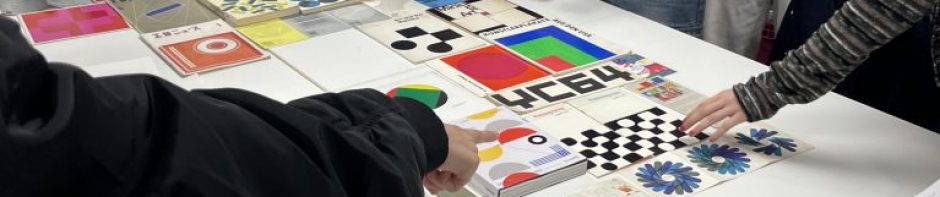
Examples of warmup exercises.
Guest lecture sessions with V&A and North Studio design teams.
References
Coyne, R.D., Lee, J. & Petrova, D. 2017, ‘Re‑visiting the flipped classroom in a design context’, Journal of Learning Design, vol. 10, no. 2, pp. 1–13. Available at: https://www.jld.edu.au/article/download/281/281‑765‑1‑PB.pdf [Accessed 15 February 2026].
McAlhone, B. and Stuart, D. (1996) A Smile in the Mind: Witty Thinking in Graphic Design. London: Phaidon Press.
Nielsen, D. and Granholm, K. (2016) Creative Thinker’s Exercise Book. Amsterdam: BIS Publishers. ISBN 978‑90‑6369‑438‑8.
Sawyer, R.K. (2019) The role of failure in learning how to create in art and design. Thinking Skills and Creativity, 33, p.100527. doi:10.1016/j.tsc.2018.08.002.